Washington

Washington ranks 31st in industrial emissions. Excluding power plants, refineries and waste are the highest-emitting sectors. Pulp and paper, aircraft manufacturing, and food production are also prominent industries. Industrial activity is concentrated in the western part of the state along the I-5 corridor between Seattle and Portland, Oregon. There are also clusters of industrial development around Spokane and Pasco. 
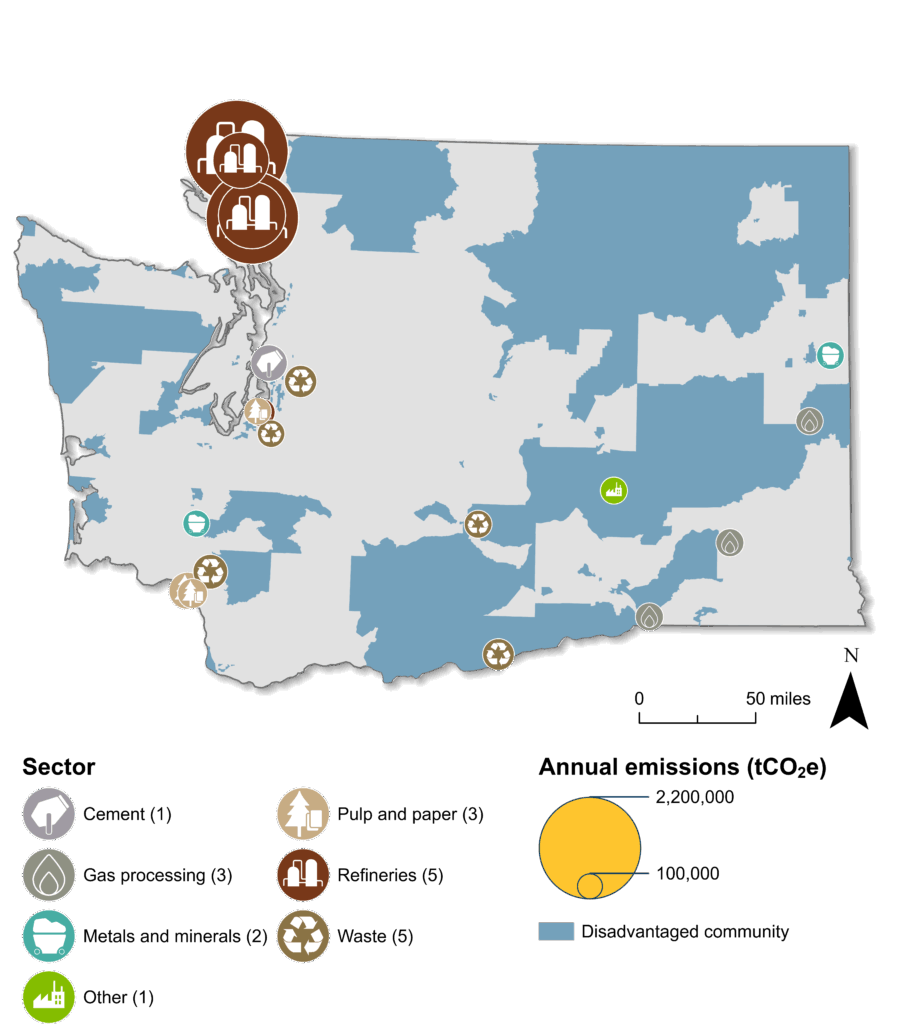
Map of Washington with shaded blue areas showing disadvantaged communities. Industrial facilities are shown and sized by their emissions. There are several large emitting refinery facilities along the coast north of Seattle.
Source: EPA GHGRP 2024, CEQ 2024
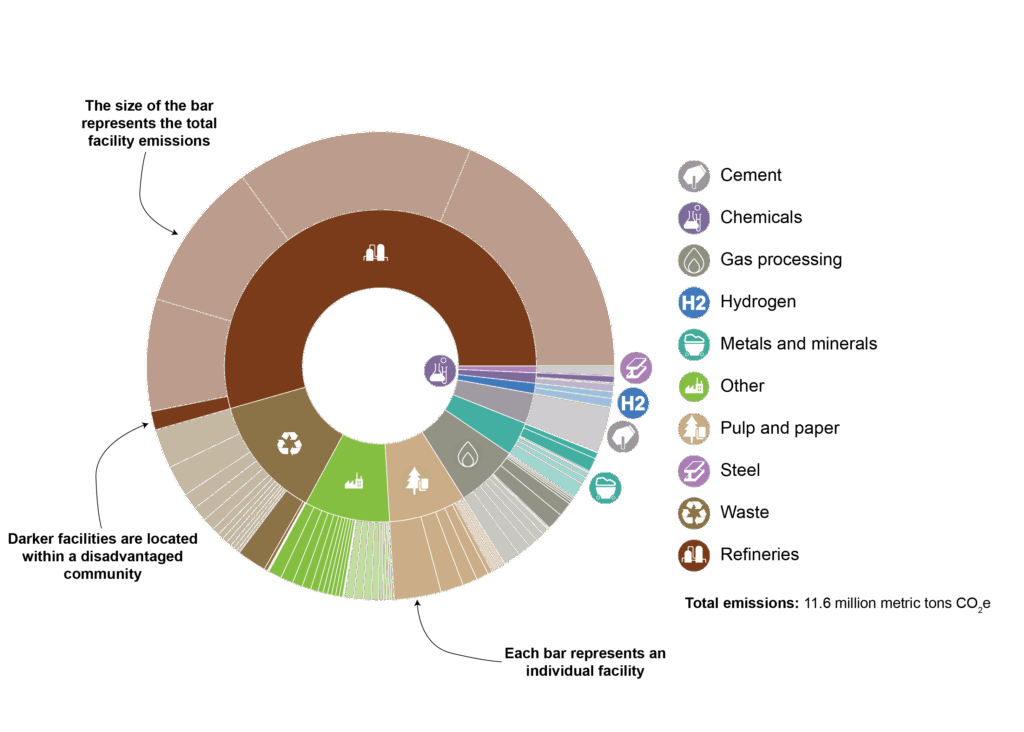
This sunburst diagram shows the breakdown of emissions from industrial facilities by sector. On the outer ring, the emissions are then further broken down by facility and the darker facilities are located within a disadvantaged community. The majority of emissions come from the refinery sector.
Source: EPA GHGRP 2024, CEQ 2024
STATE ENERGY POLICY:

Considering a state’s broader energy policy landscape is helpful when developing policies to support industrial modernization. Washington has established statutory greenhouse gas emissions targets and a clean energy standard. Washington has not established a clean heat standard. While these formal commitments are not prerequisites for innovative industrial policy, they can provide a supportive framework. In addition, streamlining permitting and establishing an efficient, transparent appeals process that engages local communities early while giving clarity and assurances to project developers are key components of effective state energy policy. Discussions around innovative industrial policy present an opportunity for broader conversations about state energy policy to ensure a mutually reinforcing strategy.

LEGISLATIVE context & opportunity:

Let us know if you are aware of additional legislation advancing industrial innovation in Washington that should be featured. The context below is not exhaustive and serves as an example of recent policies and programs and where there may be future opportunities:   

Explore recent legislation in Washington and all 50 states by clicking on a specific year: 2025 legislation2024 legislation2023 legislation.

Labor Engagement Manager for Industrial Innovation and Carbon Management, GPI

Alejandro comes to GPI from Labor Union SEIU-United Service Workers West. He represented union workers from downtown Los Angeles and LA’s westside corridor of Century City, Westwood, and Beverly Hills. Alejandro enforced various collective bargaining agreements for union workers, ensuring annual wage increases, health insurance, and other benefits and protections. In addition, he worked with union leaders and outside stakeholders, such as community partners, public agencies, politicians, and industry experts, to develop and execute union campaigns. Alejandro was also part of the Los Angeles-Justice for Janitors 2021 union contract campaign—he helped execute and coordinate large-scale actions across LA’s metropolitan area. Previously, he served as the Nevada state canvassing director at For Our Future Action Fund. He holds a BA in international studies and Italian from the University of Kansas.

Senior Program Coordinator for Industrial Innovation and Carbon Management, GPI

Carrie Danner joined the Great Plains Institute in 2023 and serves as the operations coordinator for the Industrial Innovation and Carbon Management team. In her work, she supports all projects within the program to elevate operations, particularly in grant-making and event planning. Carrie earned a bachelor’s degree from Knox College in environmental studies. Prior to joining GPI, she supported programs at the Conservation Corps of Minnesota & Iowa as their member experience administrator.

Industry Program Coordinator, GPI

Alana joined GPI in 2024 as a program associate on the Industrial Innovation and Carbon Management team, specifically supporting the Industrial Innovation Initiative, where she helps to advance industrial decarbonization through GPI’s consensus-building approach. Alana previously worked as an account executive at Jamf, where she helped current K-12 education customers improve and scale the management and security of their Apple device deployments. Alana has spent most of her professional years working with Minnesota nonprofits, including two years as an AmeriCorps member with Twin Cities Habitat for Humanity. She holds a bachelor’s degree in community environmental studies from the University of Wisconsin-Eau Claire.

Zachary Byrum, Research Analyst, WRI

Zachary Byrum is a Research Analyst in WRI's U.S. Climate Program, where he provides technology and policy analysis for carbon removal and deep decarbonization. His work focuses on pathways to reduce industrial emissions as well as bolstering technological carbon removal. Prior to WRI, Zach was a research assistant in the Carbon Management Research Initiative at the Center on Global Energy Policy. In the preceding years, he served as White House Intern in the National Economic Council under the Obama Administration and then an assistant analyst at the Congressional Budget Office. Zach holds a Master of Public Administration in Environmental Science and Policy from the School of International and Public Affairs at Columbia University and a B.A. in Economics and Political Science from Goucher College.

Senior Advisor of Industrial Innovation, WRI United States

Angela Anderson is the Director of Industrial Innovation and Carbon Removal in the Climate Program. She leads WRI's growing portfolio of work in industrial decarbonization and carbon removal and aims to change narratives around “hard-to-abate” sectors and promote the natural and technological interventions required to achieve net-zero targets. Prior to joining WRI, Angela worked as a program director, coalition builder, international advocate, and campaign strategist. She led the Climate and Energy Program at the Union of Concerned Scientists for ten years; facilitated US-NGO engagement in the international climate negotiations while at US Climate Action Network and at the Pew Environmental Trust; and founded Clear the Air, a national coalition to reduce pollution from power plants. Angela holds a B.A. in political science from Colorado State University.

Vice President of Industrial Innovation and Carbon Management, GPI

Patrice Lahlum is the Vice President of the Industrial Innovation and Carbon Management program at the Great Plains Institute. The Institute, headquartered in Minneapolis, MN, works with diverse stakeholders and communities across the country to transform the energy system to benefit people, the economy, and the environment. We strive to combine our unique consensus-building approach, expert knowledge and analysis, and local action to promote solutions that strengthen communities, shore up the nation’s industrial base, and enhance domestic energy independence, all while eliminating carbon emissions. Patrice oversees several initiatives, including the Carbon Capture Coalition, Industrial Innovation Initiative, Carbon Action Alliance, and the Regional Carbon Capture Deployment Initiative.

Senior Content Specialist for Industrial Innovation and Carbon Management, GPI

Kate Sullivan joined the Great Plains Institute in 2019. As Senior Content Specialist, Kate uses her analytical and design skills to provide research, writing, and logistical support across the Industrial Innovation and Carbon Management team. Prior to joining GPI, Kate worked as an Energy Counselor in the Center for Energy and Environment’s residential department, assisting homeowners with their energy needs and providing resources for efficiency upgrades. Kate earned her BA in Biology from St. Olaf College with an emphasis in Environmental Studies.

Senior Program Manager for Industrial Innovation and Carbon Management, GPI

Jill Syvrud joined the Great Plains Institute in 2017 and serves as the program manager for the Industrial Innovation and Carbon Management Program. In addition to overseeing the overall program, Jill directly supports the Industrial Innovation Initiative, a coalition advancing decarbonization solutions for the Midcontinent region’s most important industrial sectors. Jill earned a bachelor of science in biology from the University of Wisconsin–Eau Claire and a master of science degree in science technology and environmental policy from the University of Minnesota’s Humphrey School of Public Affairs. Jill’s past experience includes multiple graduate research assistantships concentrating on technology innovation and sustainable megacities, as well as a previous position as an administrative and outreach coordination intern with the Midwest Renewable Energy Association.