
North Carolina
North Carolina ranks 28th in the nation in industrial emissions. Chemicals, glass, landfills, and pulp and paper production are the highest emitting sectors. North Carolina is responsible for 8 percent of the nation’s emissions from glass production and more than 3 percent of nationwide emissions in the pulp and paper sector. Industrial production is concentrated in the Charlotte, Fayetteville, Raleigh-Durham, and Winston-Salem areas.
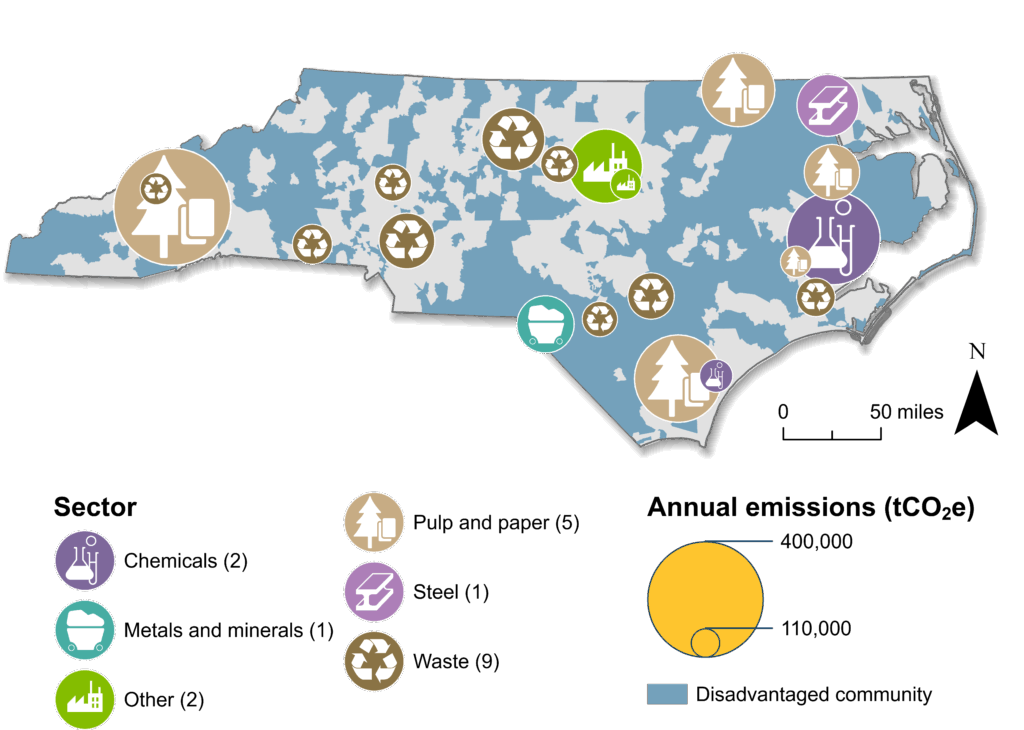
- The top 20 emitters are shown on this map, coded by industrial sector. The size of the circles corresponds to emissions: the larger the circle, the higher the emissions.
- Disadvantaged communities (as determined by the federal government) are shaded blue.
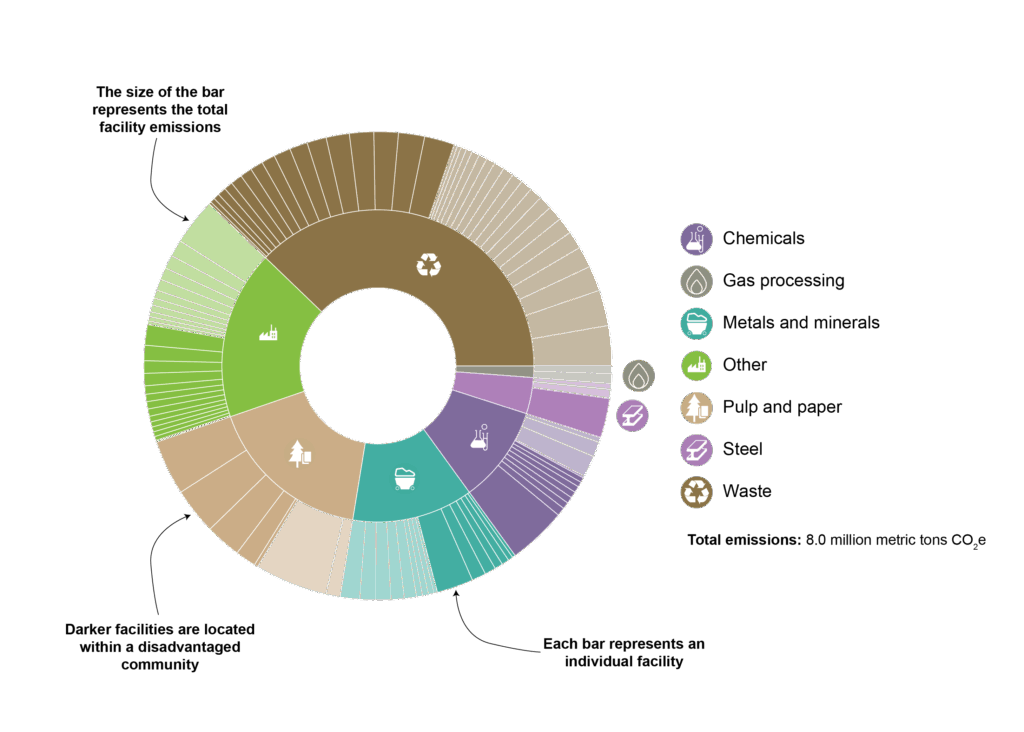
- The inner circle provides a visual representation of the share of emissions generated by each industrial sector.
- The outer circle also indicates the share of a sector’s emissions generated in disadvantaged communities.
STATE ENERGY POLICY:
Examining a state’s broader energy policy landscape is helpful when considering policies to support industrial innovation. North Carolina set statutory and executive greenhouse gas emissions targets and has a renewable energy and energy efficiency portfolio standard. North Carolina does not currently have a clean heat standard. While these formal commitments are not prerequisites for innovative industrial policy, they can provide a supportive framework. In addition, the development of effective state energy policy requires several key components: streamlining permitting and establishing an efficient, transparent appeals process that engages local communities early while giving clarity and assurances to project developers. Discussions around innovative industrial policy present an opportunity for broader conversations about state energy policy to ensure a mutually reinforcing strategy.
STATE LEGISLATIVE context & opportunity:
Let us know if you are aware of additional legislation advancing industrial innovation in North Carolina that should be featured. The context below is not exhaustive and serves as an example of recent policies and programs, and where there may be future opportunities:
- The North Carolina Energy Policy Council advises the governor and General Assembly on legislation and rulemaking that addresses domestic energy, the environment, and economic development. Industrial energy efficiency recommendations were among those made in their 2024 biennial report, including investigating opportunities to expand combined heat and power deployment for industrial buildings and analyzing the costs and benefits of electrifying industrial operations to reduce energy burden and emissions.
- A factsheet by the Renewable Thermal Collaborative identifies electrification of North Carolina’s plastic recycling, pulp and paper, and container glass subsectors as opportunities to reduce emissions significantly.
Explore more state legislation related to industrial innovation by clicking on a specific year: 2025 legislation, 2024 legislation, 2023 legislation.