
Montana
Refineries and chemical production account for nearly two-thirds of Montana’s industrial emissions. Cement and lime production are also significant sources of emissions. Centers for industrial production include Billings, Butte, and Great Falls. Mineral production is concentrated in southwestern Montana. The state’s three largest refineries are in or near Billings.
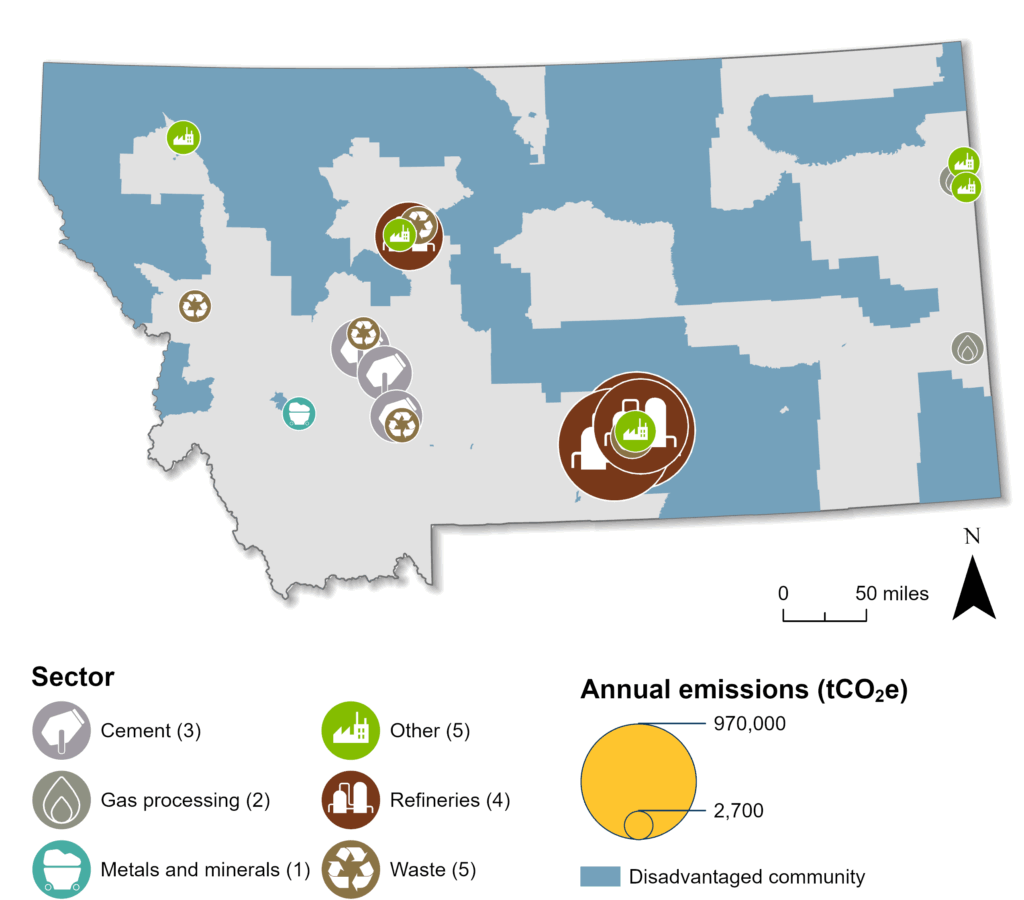
- The top 20 emitters are shown on this map, coded by industrial sector. The size of the circles corresponds to emissions: the larger the circle, the higher the emissions.
- Disadvantaged communities (as determined by the federal government) are shaded blue.
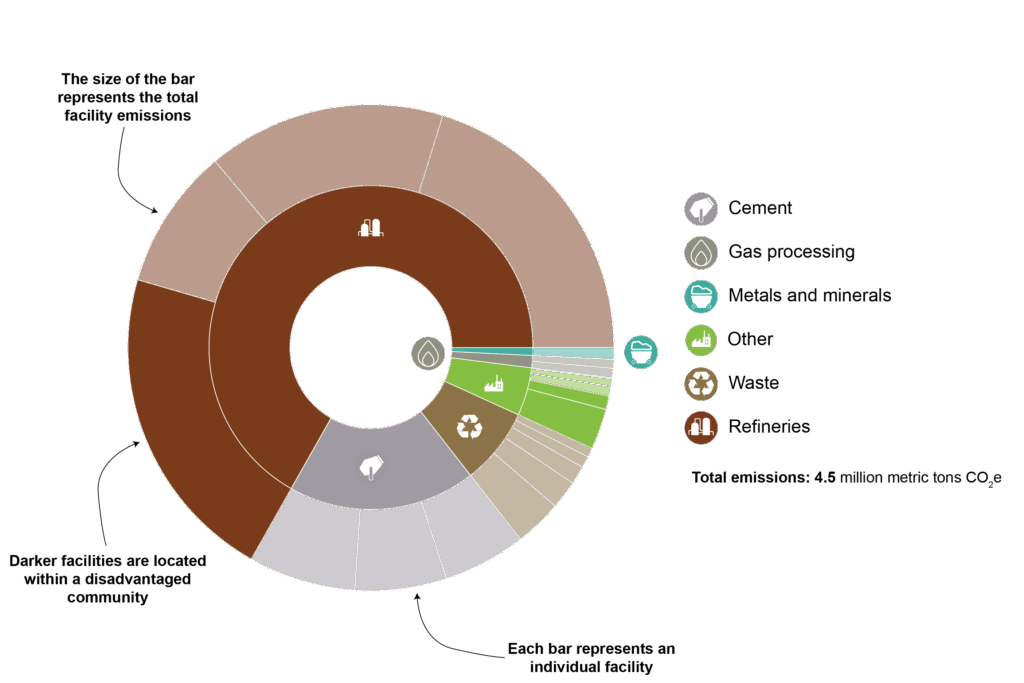
- The inner circle provides a visual representation of the share of emissions generated by each industrial sector.
- The outer circle also indicates the share of a sector’s emissions generated in disadvantaged communities.
State Energy Policy:
Examining a state’s broader energy policy landscape is helpful when considering policies to support industrial innovation. Montana established an executive greenhouse gas reduction target in 2019 and repealed its renewable portfolio standard in 2021. While these formal commitments are not prerequisites for innovative industrial policy, they can provide a supportive framework.
Streamlining permitting and establishing an efficient, transparent appeals process that engages local communities early, while providing clarity and assurances to project developers, are also key components of effective state energy policy. Discussing innovative industrial policy presents an opportunity for broader conversations about state energy policy, ensuring a mutually reinforcing strategy.
LEGISLATIVE context & opportunity:
The context below is not exhaustive and serves as an example of recent policies and programs, highlighting potential future opportunities. Please let us know if you are aware of additional efforts advancing industrial innovation in Montana that we should highlight.
- Pacific Northwest Hydrogen Association (PNWH2) includes Montana, Oregon, and Washington. Independent of the outcome of the federal funding that initially supported the regional hubs, there is interest in building a clean hydrogen economy.
- Heartland Hydrogen Hub (HH2H) also includes Montana, along with North Dakota, South Dakota, Minnesota, Wisconsin, and Colorado.
- A factsheet by the Regional Carbon Capture Deployment Initiative describes how carbon capture can reduce industrial emissions in Montana, including economically feasible subsectors and facilities that qualify for the federal 45Q tax credit.
Explore recent legislation in Montana and all 50 states by clicking on a specific year: 2025 legislation, 2024 legislation, 2023 legislation.