
Connecticut
Waste and petroleum and natural gas systems are the highest-emitting sectors in Connecticut. Universities and machine manufacturing are also significant sources of emissions. Industrial facilities are located throughout southern and central Connecticut. Approximately half of the state’s industrial facilities are in the Hartford and New London areas.
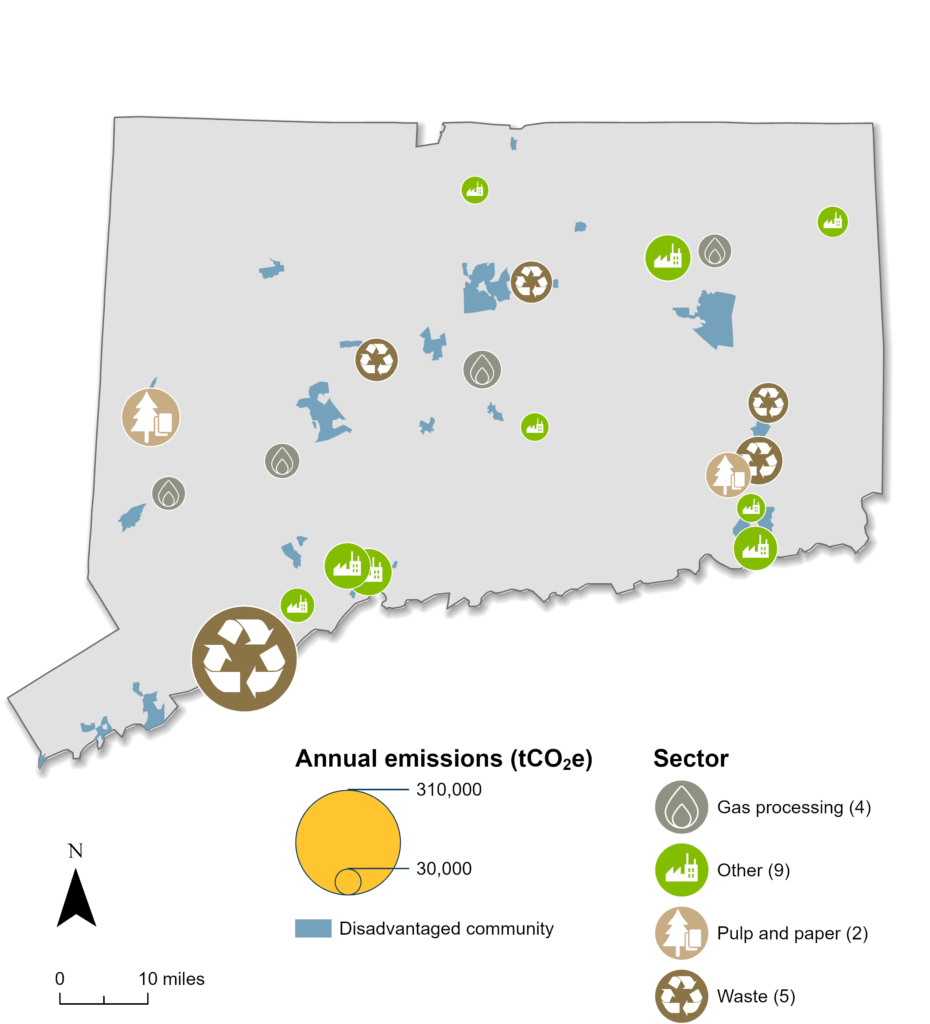
- The top 20 emitters are shown on this map, coded by industrial sector. The size of the circles corresponds to emissions: the larger the circle, the higher the emissions.
- Disadvantaged communities (as determined by the federal government) are shaded blue.
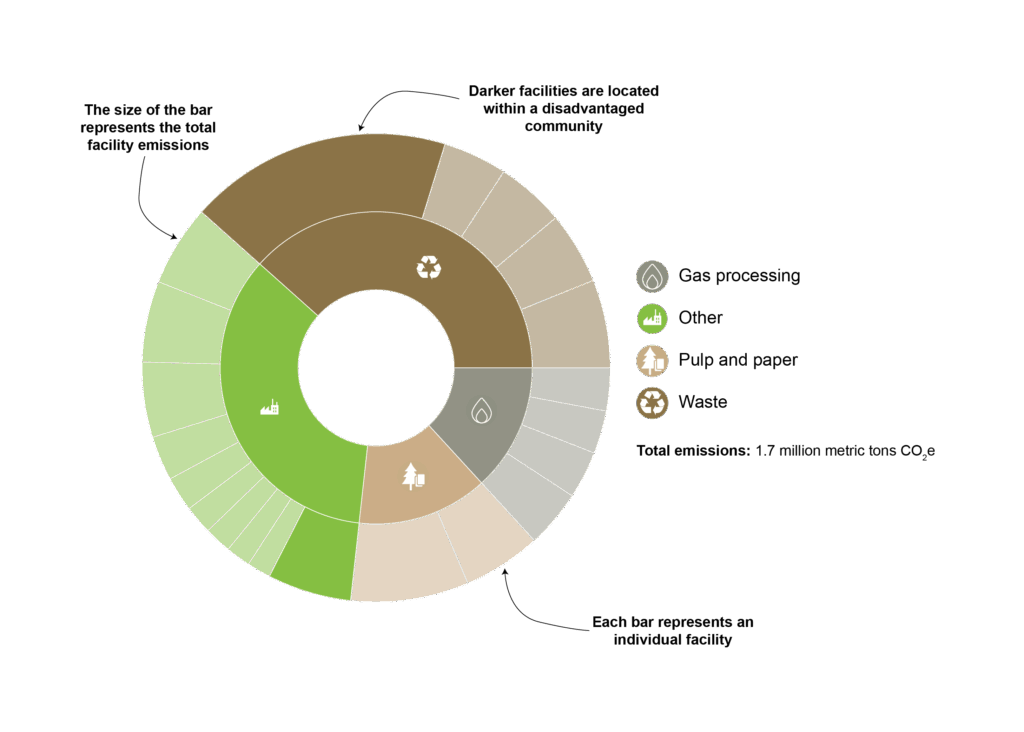
- The inner circle provides a visual representation of the share of emissions generated by each industrial sector.
- The outer circle also indicates the share of a sector’s emissions generated in disadvantaged communities.
State Energy Policy:
Examining a state’s broader energy policy landscape is helpful when considering policies to support industrial innovation. Connecticut established a statutory greenhouse gas emissions reduction target in 2025, building on several previous targets, and updated its renewable portfolio standard in 2018. While these formal commitments are not prerequisites for innovative industrial policy, they can provide a supportive framework.
Streamlining permitting and establishing an efficient, transparent appeals process that engages local communities early, while providing clarity and assurances to project developers, are also key components of effective state energy policy. Discussing innovative industrial policy presents an opportunity for broader conversations about state energy policy, ensuring a mutually reinforcing strategy.
LEGISLATIVE context & opportunity:
The context below is not exhaustive and serves as an example of recent policies and programs, highlighting potential future opportunities. Please let us know if you are aware of additional efforts advancing industrial innovation in Connecticut that we should highlight.
- Connecticut’s Office of the Clean Economy focuses on advancing clean energy supply chains to increase energy efficiency across sectors and drive economic growth. The effort includes programs like CT SMARTE, which helps small and medium-sized manufacturers reduce energy costs and emissions.
- GreenGain was launched in 2024 as a year-long pilot program to help small manufacturers integrate energy efficiency, renewable energy, and other technologies and strategies into their operations.
- Brownfield Remediation and Development provides financial and technical assistance to municipalities, economic development agencies, brownfield owners, and potential developers to return brownfield sites to productive reuse, including industrial uses.
Explore recent legislation in Connecticut and all 50 states by clicking on a specific year: 2025 legislation, 2024 legislation, 2023 legislation.