
• 5 MIN READ

Industrial Innovation Initiative Releases State Toolkit for Industrial Decarbonization


Key Takeaways

  • America’s industrial sector produces the essential building blocks of modern life, powering the economy and providing millions of well-paying jobs. Industrial emissions account for nearly a third of US emissions (including direct and indirect emissions from electrical consumption), and “business as usual” is putting it on track to be the highest emitting sector by the early 2030s.
  • States are taking action to reduce industrial emissions. In 2024, the Oklahoma legislature appropriated $50 million to establish a revolving fund for retrofits of oil and gas equipment. In Colorado, the Colorado Industrial Tax Credit Offering provides $168 million in tax credits to industrial facilities that implement qualifying emissions reductions. Pennsylvania will deploy $396 million in federal support that is expected to unleash $1 billion in investments to reduce industrial emissions.
  • Reaching midcentury climate goals will require states and manufacturers to lead in tackling industrial emissions.
  • The toolkit is a hub that provides the context and information needed to confidently communicate industry’s role in the energy transition, identify actionable measures states can take to reduce emissions, and easily direct stakeholders to key technical partners and peer projects.

Meeting midcentury climate goals will require an industrial transformation, and states will play a vital role. The Industrial Innovation Initiative (I3) is excited to announce the release of its State Toolkit for Industrial Decarbonization. The toolkit aims to help state officials and industry leaders make informed decisions and take actionable measures to reduce emissions while supporting a stable climate, a safe and healthy environment, a thriving livelihood for American workers, and a strong US economy.

The toolkit is a hub for essential industrial decarbonization resources and connections. It is a living resource that will be expanded over time to include updated information. The toolkit provides an overview of the industrial context as well as the landscape of emissions and legislation for individual states before diving into three key sections:
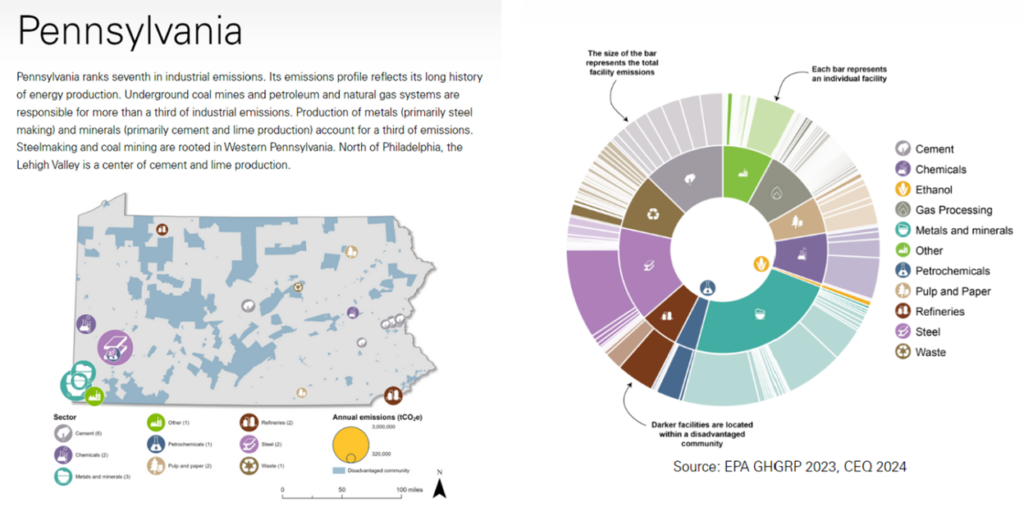
Use the state pages to see the geographic distribution of top-emitting sectors, including the share of a sector’s emissions generated in disadvantaged communities.
  • Section 1 – Industrial Electrification: Learn more about how electrifying industrial processes is one of the most promising ways to reduce emissions in the near term through ready-made 101 resources and case studies.
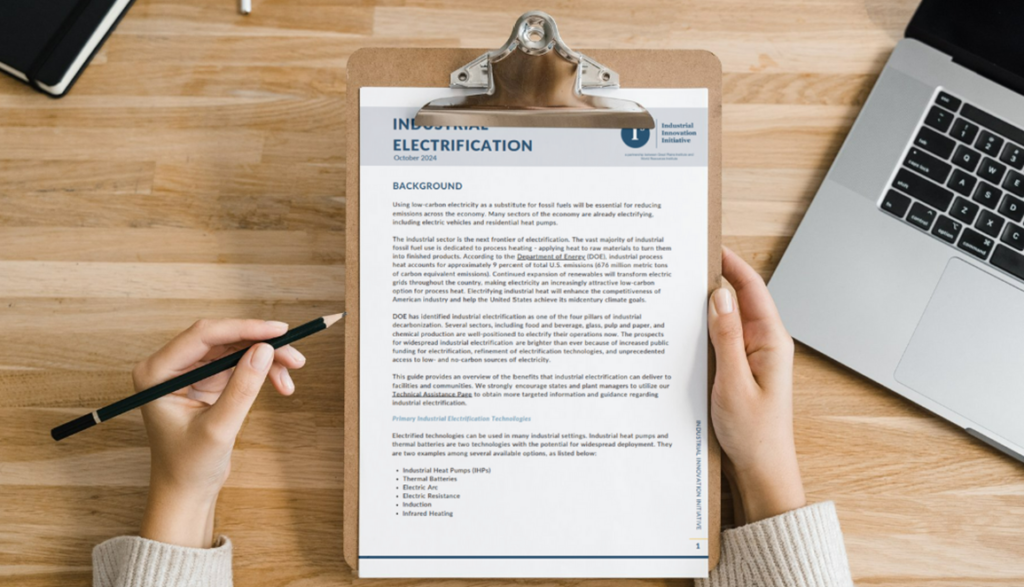
Share ready-made guides on industrial electrification that are formatted for easy distribution.
  • Section 2 – Technical Assistance: Easily identify and direct stakeholders to key technical partners and peer industrial decarbonization projects.
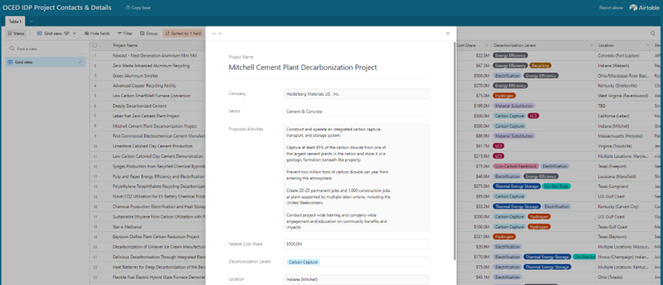
Use the Industrial Demonstration Program AirTable to identify project details and contact information for peer projects by
  • Section 3 – Additional Resources: Develop a deeper understanding of the wide-ranging topic of industrial decarbonization, including several external resources that can help expedite the adoption of clean energy policy and technology.

Whether you are a manufacturer planning a facility upgrade, a state official looking to ensure that energy transition resources benefit disadvantaged communities, or an elected official seeking examples of effective legislation in other states, the toolkit provides essential resources and connections to support your work. We encourage you to explore the I3 State Toolkit for Industrial Decarbonization to identify the technologies, policies, and partners you can leverage today to take meaningful, actionable measures to reduce industrial emissions in your state.

Share this post


Stay current

Keep up with I3 by joining our Newsletter.

Subscription

"*" indicates required fields

This field is for validation purposes and should be left unchanged.
Labor Engagement Manager for Industrial Innovation and Carbon Management, GPI

Alejandro comes to GPI from Labor Union SEIU-United Service Workers West. He represented union workers from downtown Los Angeles and LA’s westside corridor of Century City, Westwood, and Beverly Hills. Alejandro enforced various collective bargaining agreements for union workers, ensuring annual wage increases, health insurance, and other benefits and protections. In addition, he worked with union leaders and outside stakeholders, such as community partners, public agencies, politicians, and industry experts, to develop and execute union campaigns. Alejandro was also part of the Los Angeles-Justice for Janitors 2021 union contract campaign—he helped execute and coordinate large-scale actions across LA’s metropolitan area. Previously, he served as the Nevada state canvassing director at For Our Future Action Fund. He holds a BA in international studies and Italian from the University of Kansas.

Senior Program Coordinator for Industrial Innovation and Carbon Management, GPI

Carrie Danner joined the Great Plains Institute in 2023 and serves as the operations coordinator for the Industrial Innovation and Carbon Management team. In her work, she supports all projects within the program to elevate operations, particularly in grant-making and event planning. Carrie earned a bachelor’s degree from Knox College in environmental studies. Prior to joining GPI, she supported programs at the Conservation Corps of Minnesota & Iowa as their member experience administrator.

Industry Program Coordinator, GPI

Alana joined GPI in 2024 as a program associate on the Industrial Innovation and Carbon Management team, specifically supporting the Industrial Innovation Initiative, where she helps to advance industrial decarbonization through GPI’s consensus-building approach. Alana previously worked as an account executive at Jamf, where she helped current K-12 education customers improve and scale the management and security of their Apple device deployments. Alana has spent most of her professional years working with Minnesota nonprofits, including two years as an AmeriCorps member with Twin Cities Habitat for Humanity. She holds a bachelor’s degree in community environmental studies from the University of Wisconsin-Eau Claire.

Zachary Byrum, Research Analyst, WRI

Zachary Byrum is a Research Analyst in WRI's U.S. Climate Program, where he provides technology and policy analysis for carbon removal and deep decarbonization. His work focuses on pathways to reduce industrial emissions as well as bolstering technological carbon removal. Prior to WRI, Zach was a research assistant in the Carbon Management Research Initiative at the Center on Global Energy Policy. In the preceding years, he served as White House Intern in the National Economic Council under the Obama Administration and then an assistant analyst at the Congressional Budget Office. Zach holds a Master of Public Administration in Environmental Science and Policy from the School of International and Public Affairs at Columbia University and a B.A. in Economics and Political Science from Goucher College.

Senior Advisor of Industrial Innovation, WRI United States

Angela Anderson is the Director of Industrial Innovation and Carbon Removal in the Climate Program. She leads WRI's growing portfolio of work in industrial decarbonization and carbon removal and aims to change narratives around “hard-to-abate” sectors and promote the natural and technological interventions required to achieve net-zero targets. Prior to joining WRI, Angela worked as a program director, coalition builder, international advocate, and campaign strategist. She led the Climate and Energy Program at the Union of Concerned Scientists for ten years; facilitated US-NGO engagement in the international climate negotiations while at US Climate Action Network and at the Pew Environmental Trust; and founded Clear the Air, a national coalition to reduce pollution from power plants. Angela holds a B.A. in political science from Colorado State University.

Vice President of Industrial Innovation and Carbon Management, GPI

Patrice Lahlum is the Vice President of the Industrial Innovation and Carbon Management program at the Great Plains Institute. The Institute, headquartered in Minneapolis, MN, works with diverse stakeholders and communities across the country to transform the energy system to benefit people, the economy, and the environment. We strive to combine our unique consensus-building approach, expert knowledge and analysis, and local action to promote solutions that strengthen communities, shore up the nation’s industrial base, and enhance domestic energy independence, all while eliminating carbon emissions. Patrice oversees several initiatives, including the Carbon Capture Coalition, Industrial Innovation Initiative, Carbon Action Alliance, and the Regional Carbon Capture Deployment Initiative.

Senior Content Specialist for Industrial Innovation and Carbon Management, GPI

Kate Sullivan joined the Great Plains Institute in 2019. As Senior Content Specialist, Kate uses her analytical and design skills to provide research, writing, and logistical support across the Industrial Innovation and Carbon Management team. Prior to joining GPI, Kate worked as an Energy Counselor in the Center for Energy and Environment’s residential department, assisting homeowners with their energy needs and providing resources for efficiency upgrades. Kate earned her BA in Biology from St. Olaf College with an emphasis in Environmental Studies.

Senior Program Manager for Industrial Innovation and Carbon Management, GPI

Jill Syvrud joined the Great Plains Institute in 2017 and serves as the program manager for the Industrial Innovation and Carbon Management Program. In addition to overseeing the overall program, Jill directly supports the Industrial Innovation Initiative, a coalition advancing decarbonization solutions for the Midcontinent region’s most important industrial sectors. Jill earned a bachelor of science in biology from the University of Wisconsin–Eau Claire and a master of science degree in science technology and environmental policy from the University of Minnesota’s Humphrey School of Public Affairs. Jill’s past experience includes multiple graduate research assistantships concentrating on technology innovation and sustainable megacities, as well as a previous position as an administrative and outreach coordination intern with the Midwest Renewable Energy Association.