
New York
New York ranks 25th in the nation for industrial emissions. The highest emitting sectors are minerals, petroleum, and natural gas systems, and waste. Universities and hospitals also represent a significant source of emissions. Most industrial production is concentrated in and near the state’s major cities: Albany, Binghamton, Buffalo, New York City, and Syracuse. Many of the state’s largest industrial facilities, including manufacturers of cement, paper, and plastics, are located within an hour’s drive of Albany.
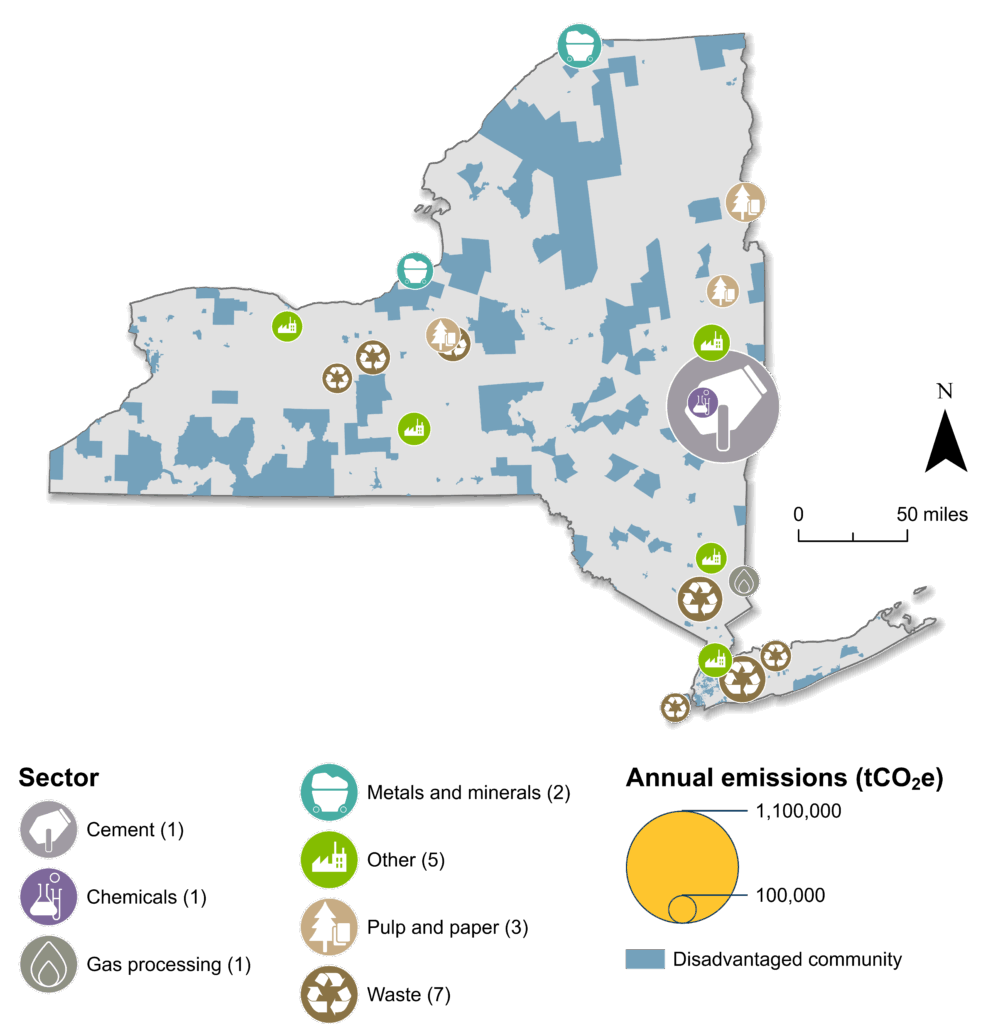
- The top 20 emitters are shown on this map, coded by industrial sector. The size of the circles corresponds to emissions: the larger the circle, the higher the emissions.
- Disadvantaged communities (as determined by the federal government) are shaded blue.
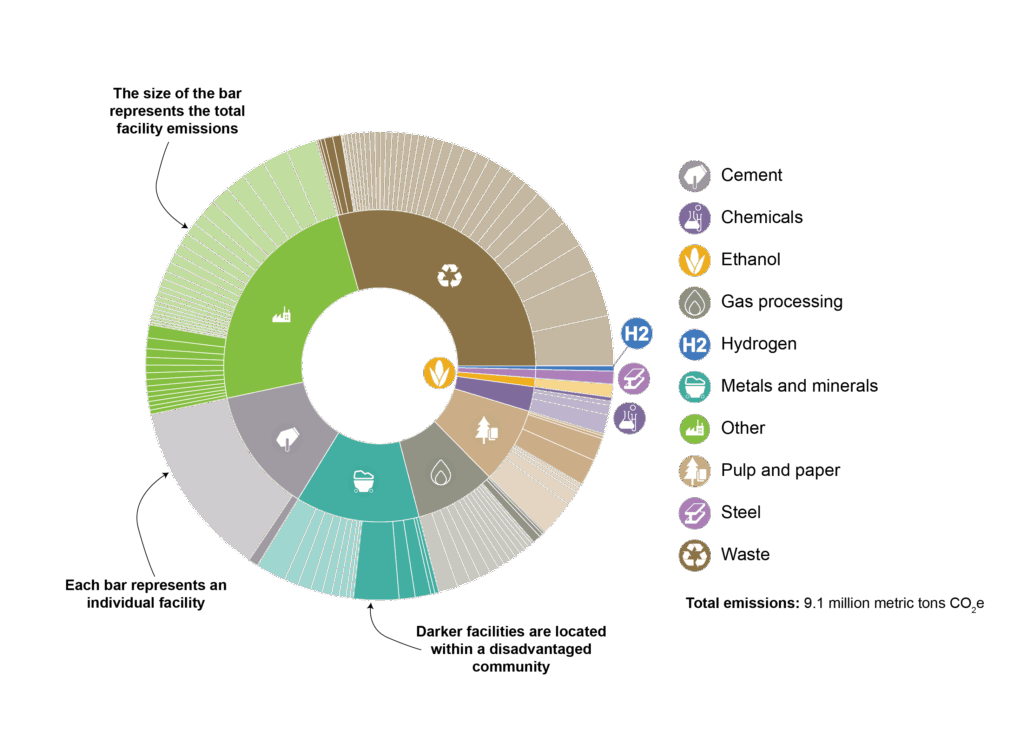
- The inner circle provides a visual representation of the share of emissions generated by each industrial sector.
- The outer circle also indicates the share of a sector’s emissions generated in disadvantaged communities.
STATE ENERGY POLICY:
Examining a state’s broader energy policy landscape is helpful when considering policies that will support industrial innovation. New York has established statutory greenhouse gas emissions targets as well as a renewable portfolio standard and a clean energy standard. New York does not have a clean heat standard, but it committed in 2023 to exploring it. While these formal commitments are not prerequisites for innovative industrial policy, they can provide a supportive framework. In addition, the development of effective state energy policy requires several key components: streamlining permitting and establishing an efficient, transparent appeals process that engages local communities early while giving clarity and assurances to project developers. Discussions around innovative industrial policy present an opportunity for broader conversations about state energy policy to ensure a mutually reinforcing strategy.
STATE LEGISLATIVE context & opportunity:
Let us know if you are aware of additional legislation advancing industrial innovation in New York that should be featured. The context below is not exhaustive and serves as an example of recent policies and programs, and where there may be future opportunities:
- New York State Energy Research and Development Authority (NYSERDA) has a database of funding opportunities, many of which support implementing clean energy solutions in industrial settings. The Heat Recovery Project Development Program is an example of a cost-share program for implementing heat recovery measures, like heat pumps and thermal storage.
- Fast NY Shovel-Ready Grant Program is a $300 million grant program that launched in 2022 to support pre-development activities and infrastructure investments that attract eligible industries, including high-tech manufacturing, clean-tech renewable energy, and industrial machinery and other advanced manufacturing. As of early 2025, the program has awarded over $232 million and improved nearly 4,000 acres of industrial property.
- NYS Buy Clean Concrete: New York’s procurement guidelines for concrete mixes were established in 2021 with S 542A. In 2023, Executive Order 22 created additional guidelines around embodied carbon, covering concrete, asphalt, steel, and glass.
New York has enacted and considered a range of legislation that supports industrial innovation, including carbon capture, clean hydrogen, and procurement. Explore recent legislation in New York and all 50 states by clicking on a specific year: 2025 legislation, 2024 legislation, 2023 legislation.